Donyo Sabuk Avenue, Westlands: The Address That Nairobi’s Most Discerning Families Keep Choosing
There are streets in every city that quietly accumulate the right kind of reputation. Not through marketing. Not through any single famous resident or landmark. Just through the steady accumulation of the right kind of development, the right kind of neighbours, and the kind of daily life that people who have tried other addresses eventually migrate toward.
Donyo Sabuk Avenue in Westlands is one of those streets.
If you have spent any time looking at premium family apartments in Nairobi, you have probably encountered the address without necessarily understanding why it keeps appearing at the top of the shortlists, why diplomats request it. Why do the developers who build for the high end of the Westlands market choose it? Why families who have lived in Kilimani or along Rhapta Road or in the more commercial parts of Westlands eventually end up asking about it.
This article is the answer to that question. It is a street-level account of what Ndonyo Sabuk Avenue actually is, who lives there, what makes it different from the rest of Westlands, and why the apartments being built there right now represent some of the most compelling property available in Nairobi in 2026.
Own It Kenya has been operating in Westlands for over 15 years. We are the exclusive listing agent for Golden Hill, which is currently the flagship off-plan development on this avenue. We know this street well. What follows is our honest account of it.
Where Donyo Sabuk Avenue Actually Is
Donyo Sabuk Avenue runs off General Mathenge Drive in the northern part of Westlands — the part of the neighbourhood that most people who commute through Westlands rarely pass through.
General Mathenge Drive is itself one of Nairobi’s most consistently sought-after residential corridors: tree-lined, relatively quiet, and home to a concentration of embassies, diplomatic residences, and high-end apartment buildings that has remained stable for decades.
Donyo Sabuk branches off this corridor toward Karura Forest. That geographical fact is what defines everything about the street. As you move along it, the city falls away slightly.
The traffic thins. The buildings are fewer and better spaced. The air changes in a way that is genuinely noticeable if you have spent a long day in the GTC corridor or along Waiyaki Way.
It is still Westlands — fully connected, close to everything the neighbourhood offers. But it feels like a different version of it. Quieter. More settled. More residential in the way that the word actually means something.
The Karura Forest Connection
| From the upper floors of a building onDonyo Sabuk Avenue, you are not looking at the back of another apartment tower. You are looking at 1,041 hectares of indigenous forest that is protected, that will not be built on, and that will still be there in thirty years when the rest of Nairobi has changed completely around it. |
Karura Forest is one of Nairobi’s defining assets and one of its most underappreciated ones. Most of the city interacts with it occasionally — a Sunday cycling trip, a morning walk. Residents on Donyo Sabuk Avenue interact with it every morning without leaving their building.
The forest is the view from the balcony. It is the source of the birdsong at dawn. It is the reason the air quality on this street is measurably different from the commercial heart of Westlands, three kilometres away.
The Kenya Forest Service protects Karura under a community forest management framework. It cannot be rezoned. It cannot be sold. It cannot be developed.
In a city where every other view is one planning application away from disappearing, this permanence is not a minor feature of the address. It is a structural advantage that compounds over the years anyone lives here.
Upper-floor apartments on Donyo Sabuk Avenue with the correct orientation face this forest directly. The view changes through the day — grey-green and misty at dawn, deep and layered in the afternoon light, luminous at the golden hour before dusk.
For anyone who has spent years looking at the back of another building from their living room window in Nairobi, it is a genuinely different way to live.
It is also, practically, a rental and resale premium that does not depreciate. Long-term data from the General Mathenge and Ndonyo Sabuk corridor shows forest-facing upper-floor units consistently commanding 15 to 25% more than equivalent lower-floor or non-forest-facing units in the same buildings.
The people who pay that premium are not doing so irrationally. They are paying for something that cannot be replicated anywhere else in Westlands.
The Neighbourhood Character: Who Lives on Ndonyo Sabuk Avenue
The resident profile on Donyo Sabuk Avenue Apartments, Westlands, and the immediate General Mathenge Drive corridor tells you a lot about what kind of address it is. Senior diplomats posted to Nairobi consistently request this part of Westlands, partly for the proximity to the diplomatic zone in Gigiri and partly because the buildings and the street feel appropriate to their lifestyle requirements.
Multinational executives on 24 to 36-month corporate assignments look here first. High-net-worth Kenyan families who have decided they want Westlands but not the version of Westlands that puts them above a nightclub or a matatu terminus.
These are not people who are shopping primarily on price. They are shopping on environment — on the combination of address, security, building quality, and the character of the street outside their window. Donyo Sabuk Avenue delivers all of those things, which is why the vacancy rates in well-managed buildings on this corridor are among the lowest in Westlands.
The side effect of this tenant profile is consistency. A diplomat or a senior executive on a corporate housing allowance does not move every six months. They renew leases. They treat the property well because they are accountable to their employer for the condition it is returned in. They pay reliably. For investors, that consistency is worth more than a slightly higher headline rent from a less stable tenant.
What
- Donyo Sabuk Avenue Offers That the Rest of Westlands Doesn’t
Quiet without isolation
Nairobi has quiet residential streets. Karen is quiet. Parts of Muthaiga are very quiet. But quiet in those areas comes at the cost of distance — you are far from the city, far from the infrastructure, far from the daily convenience that Westlands delivers.
Donyo Sabuk Avenue is quiet while being three minutes from Sarit Centre, five minutes from Westgate, ten minutes from the CBD, and 22 minutes from JKIA via the Nairobi Expressway. That particular combination — residential calm with full urban connectivity — does not exist in many places in Nairobi.
Green views that are permanent
Addressed above in the Karura section, but worth repeating in the context of the broader Westlands market: most of Westlands has views of other buildings. The GTC corridor looks at the GTC. Rhapta Road looks at Rhapta Road. The Ring Road corridor looks across to other Ring Road buildings.
The Donyo Sabuk – General Mathenge corridor faces the forest. That is the distinction. And it is a distinction that no amount of interior design or rooftop amenities can replicate if the view from the balcony is someone else’s kitchen.
Lower density than commercial Westlands
The northern edge of Westlands, where Donyo Sabuk Avenue sits, has not been overdeveloped in the same way as the commercial strips further south and west. There are fewer towers, more space between buildings, and a built environment that feels scaled for residential life rather than for maximum plot ratio.
This is partly a function of the proximity to Karura Forest — development on the forest boundary is regulated more carefully — and partly a function of the type of developer who builds here.
Developers who target the senior executive and diplomatic market choose this corridor because their buyers and tenants expect a certain relationship between buildings and open space.
That has kept the density lower than the rest of Westlands, and it keeps property values on this corridor consistently higher.
Access without congestion
General Mathenge Drive connects efficiently to Peponi Road, to Runda, to Gigiri and the UN headquarters, to Parklands Road and the broader Westlands network.
The Nairobi Expressway onramp is within ten minutes, putting the airport and Upper Hill both within practical reach.
What this address does not put you in is the middle of the Waiyaki Way or Ring Road traffic that makes parts of Westlands significantly less pleasant at peak hours. You get the connectivity of Westlands without the congestion of its busiest corridors.
Key Distances from Ndonyo Sabuk Avenue
| From Donyo Sabuk Avenue | Distance / Time |
| Sarit Centre | 3 – 4 minutes by car |
| Westgate Mall | 4 – 5 minutes by car |
| GTC / Kempinski Hotel | 7 – 8 minutes by car |
| Nairobi Expressway onramp | 8 – 10 minutes by car |
| Aga Khan University Hospital | 10 minutes by car |
| International School of Kenya | 12 minutes by car |
| Nairobi CBD | 12 – 15 minutes by car |
| JKIA via Expressway | 22 – 25 minutes by car |
| UN Headquarters, Gigiri | 15 minutes by car |
| Karura Forest entrance | Walking distance from upper-floor units |
The Property Market on Ndonyo Sabuk Avenue in 2026
The apartment market on Donyo Sabuk Avenue has historically been split between completed high-quality rentals and a slow trickle of sales.
The corridor does not produce new supply quickly — the planning environment and the character of the address mean developers who build here tend to build carefully and with longer time horizons than the high-volume Westlands commercial market.
In 2026, there are several notable developments either completed or in progress along the avenue and the immediately adjacent Peponi Road and General Mathenge frontage. Completed units in existing buildings on this corridor rent for KES 200,000 to KES 500,000 per month, depending on size, floor, and furnishing level.
A well-positioned 3-bedroom plus DSQ in a quality building on this stretch, furnished to a good standard, typically finds a premium tenant within three to five weeks of listing. Vacancy periods are among the shortest in the Westlands market.
The off-plan market on this corridor is where the most compelling opportunity sits right now. Because new supply is limited and the address commands structural premiums, off-plan buyers who secure units in quality developments on this avenue are buying into a market where scarcity is built in from the first day of construction.
What types of apartments are available on Donyo Sabuk Avenue?
The corridor specialises in large-format family apartments: 3, 4, and 5-bedroom configurations with DSQ are the dominant product.
This reflects the tenant base — families and senior executives who need the space and who are specifically not looking at the 1 and 2-bedroom investor-grade product that dominates the commercial Westlands market. Studios and 1-bedrooms are rare here.
When they appear, they tend to be in the lower floors of larger buildings and rent to younger professionals who want the address but are buying in at the most accessible price point.
What do apartments on this avenue actually cost?
Completed 3-bedroom apartments with DSQ on Donyo Sabuk Avenue and the General Mathenge corridor range from approximately KES 30 million to KES 70 million, depending on the building, the floor, the view, and the specification.
Off-plan 3-bedrooms from developers with verified track records are available at lower entry points — in the KES 22 to 35 million range for well-specified units in new developments — with the premium applied at or after completion.
Rental income for well-managed 3-bedroom units on this corridor runs from KES 200,000 to KES 300,000 per month, unfurnished, and KES 250,000 to KES 380,000 furnished.
Golden Hill: The Current Best Off-Plan Opportunity on Donyo Sabuk Avenue
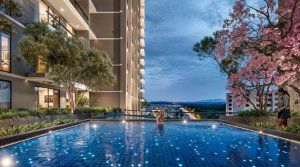
Of the off-plan developments currently available on Donyo Sabuk Avenue, Golden Hill is the one Own It Kenya is recommending most actively to buyers.
Own It Kenya is the exclusive listing agent, so we have an obvious interest in saying this, which is exactly why we will be specific about what makes it worth recommending rather than vague about how exceptional it is.
| Golden Hill — Donyo Sabuk Avenue, Westlands:
• 3, 4, and 5-bedroom apartments with genuine DSQ • 102 units on 1.04 acres — gated and genuinely low-density • Karura Forest views from upper floors — correctly oriented, verified on floor plan • Large balconies and floor-to-ceiling windows throughout • Developer backed by Golden Mansion Westlands track record • Off-plan with a payment plan over 24 to 48 months • Premium family-grade amenities: pool, gym, landscaped grounds, children’s play area, 24-hour security • Contact: sales@ownitkenya.com / +254 722 716 182 |
The 102-unit density is the number that matters most for investors. On the same Donyo Sabuk Avenue apartments corridor, there are competing developments with 200 or more units on similar land parcels.
The practical effect of that difference: in a 102-unit building, your 3-bedroom is not competing with 30 identical units when you want to rent it. In a 200-unit building, it is. That is a supply-side advantage that is permanent — the building will never gain more units after it is constructed.
The forest views are the second thing that matters. Not all Golden Hill units have full forest views. Upper floors with the correct orientation do. This is one of the primary reasons to engage at the off-plan stage: you choose your floor and orientation before anyone else.
The forest-facing upper-floor 3-bedroom will always be worth more than the same unit without that view. Getting in early at off-plan pricing means you capture that premium at no additional cost.
For current pricing, floor plan details, and payment plan structure, contact Own It Kenya directly. Pricing is confirmed during the reservation conversation rather than published broadly, which allows us to have a proper discussion about which specific unit and floor configuration makes the most sense for your situation.
Who Should Be Looking at Donyo Sabuk Avenue apartments
Families upgrading within Westlands
If you are already in Westlands in a 2-bedroom or a smaller 3-bedroom in a denser part of the neighbourhood, and you are thinking about what the next ten years look like, Donyo Sabuk Avenue is the natural next move.
You keep the Westlands connectivity, the school access, and the infrastructure. You trade the density and the noise for a building with fewer neighbours, a street with fewer cars, and a view that does not require looking down at a car park.
First-time buyers in the premium segment
If your budget puts you in the KES 25 to 40 million range and you are buying your first significant property in Nairobi, the Donyo Sabuk Avenue apartments corridor offers an entry point into an address that historically holds its value better than equivalent-priced properties in more generic parts of Westlands.
The combination of address quality, view, and low new supply means that a purchase on this corridor does not typically suffer from the localised oversupply problems that affect some other Westlands sub-markets.
Investors targeting the diplomatic and corporate rental market
The tenant profile on this corridor — senior diplomats, multinational executives, high-net-worth families — is the most stable and highest-paying in the Westlands rental market. These tenants renew. They pay corporate rates. They maintain the property.
If you are building a rental portfolio in Westlands and you want the end of the market where vacancy is shortest, and yields are most reliable, Donyo Sabuk Avenue is where you should be looking.
Diaspora buyers planning for return
If you are in the UK, USA, Canada, UAE, or Australia and you are planning a return to Nairobi over the next five to ten years, an off-plan 3-bedroom on Donyo Sabuk Avenue apartments bought now at 2026 pricing is a coherent long-term plan. The off-plan process is fully remote-capable.
Own It Kenya manages the purchase and the subsequent rental of the property while you are abroad. By the time you return, you own a fully paid-for apartment in one of Nairobi’s most consistently desirable addresses, with several years of rental income on the ledger.
If You Are Thinking About Donyo Sabuk Avenue apartments
The most useful thing you can do is have a conversation with someone who knows the street, knows the buildings, and will tell you what is actually available rather than what sounds good in a listing description. Own It Kenya has been on this corridor for 15 years.
We know which floors have the forest view and which do not. We know which developers on the avenue have delivered before and which have not. We know what the current off-plan pricing looks like and what the realistic rental income is for the units we are listing.
Golden Hill is the development we are recommending most actively right now. It is off-plan, which means the best floors are still available, and the payment plan is spread across the construction period. It is on Ndonyo Sabuk Avenue, which means everything described in this article applies.
And it is 102 units on 1.04 acres, which means the supply constraint that makes this address valuable is built into the development from the first day.
Reach out. We are available by WhatsApp, email, and Zoom for diaspora buyers across the UK, USA, Canada, UAE, and Australian time zones. No script, no pressure. Just 15 years of knowing this address and telling buyers what we would do if it were our money.
| Contact Own It Kenya:
• Website: www.ownitkenya.com • Email: sales@ownitkenya.com • Phone / WhatsApp: +254 722 716 182 • Phone / WhatsApp: +254 720 469 282 • Office: Parklands, Nairobi — exclusive listing agent for Golden Hill, Ndonyo Sabuk Avenue • Zoom consultations available: UK, USA, Canada, UAE, and Australia |
About Own It Kenya
Own It Kenya is a licensed property letting, sales, and management company founded by Mr. Karue Mwaniki, based in Parklands, Nairobi. We are the listing agent for Golden Hill on Ndonyo Sabuk Avenue, Westlands. With over 15 years of experience managing and selling property across Westlands, Kilimani, Kileleshwa, Lavington, and Riverside, we serve families, investors, and diaspora buyers across all major markets.
sales@ownitkenya.com • +254 722 716 182 • +254 720 469 282 • www.ownitkenya.com